Every major AI company now runs a crawler across the open web, and a growing number of website owners have started asking the same practical question. If these systems can read markdown so much more cleanly than HTML, why not just serve it to them directly? The honest answer runs through a genuinely useful, decades old piece of the HTTP protocol called content negotiation, a newer and much debated file called llms.txt, and a fair amount of confusion about which of the two actually does what.
This guide works through both properly, without the hype that usually surrounds this topic. It covers what content negotiation for markdown actually is, how the mechanism works end to end, and why it actually matters for generative engine optimization. Then it walks through the honest, evidence based answer to whether GPTBot, ClaudeBot, PerplexityBot, and Google-Extended currently support it, explains where llms.txt fits alongside content negotiation rather than instead of it, including Google's clear public position on the file, and closes with practical steps for checking crawler access and optimizing a site's structure so that whichever AI system shows up next can actually read what matters most.
What Is Content Negotiation for Markdown?
Content negotiation is a mechanism built into HTTP itself, not something new invented for the AI era. When a browser or any other client requests a page, it sends an Accept header listing the formats it can handle. A browser typically asks for text/html. A server reads that header and decides which representation of the requested resource to send back. The same underlying resource, one URL, can be returned as HTML to a browser, JSON to a mobile app, or an RSS feed to a reader, all decided by what the requesting client actually asked for.
Applied to markdown, the pattern works the same way. A client that wants a cleaner, lighter version of a page sends Accept: text/markdown instead of Accept: text/html. If the server supports this, it returns the same content stripped of navigation, scripts, and layout markup, formatted as plain markdown instead. The Content Type header on the response confirms which format actually came back. The text/markdown media type itself was formally registered through RFC 7763 in March 2016, so this is not a workaround someone improvised for large language models. It is a standard type the web already had, being put to a new use.
The important distinction is that content negotiation happens at the same URL. A page at yoursite.com/guide stays at that one address no matter which format gets served. This differs from publishing a second, separate page such as yoursite.com/guide.md, which creates a distinct URL that a search engine can discover, index, and potentially treat as a duplicate. That distinction matters more than it sounds, and it comes back later in this guide.
How Content negotiation for agents actually work
The mechanics are simple enough to test in a terminal. A normal browser request looks something like this:
Accept: text/html,application/xhtml+xml,application/xml;q=0.9,*/*;q=0.8
An agent that wants markdown instead sends something closer to this:
Accept: text/markdown
or, when it wants to state a preference rather than demand one single format:
Accept: text/markdown;q=1.0, text/html;q=0.7
That q value is HTTP's way of expressing a weighted preference between zero and one. A server that understands content negotiation reads this header, matches it against the formats it can actually produce, and returns whichever representation scores highest. It also sets a response header, Vary: Accept, which tells any cache sitting in front of the server, a CDN for example, to store the HTML version and the markdown version separately rather than mixing them up and serving the wrong one to the wrong visitor.
This is different from two other approaches that often get grouped in with it. One is URL based routing, where a site simply publishes a second address ending in .md for every page. The other is guessing by user agent string, where a server tries to match a crawler's name and serve markdown based on that guess rather than reading what the client actually requested through the Accept header. Guessing can work in practice, but it is not negotiation, and it breaks the moment an unfamiliar agent shows up.
Real tools already use the proper mechanism today. Research published by Checkly in February 2026 tested seven coding agents and found that three, Claude Code, Cursor, and OpenCode, sent a genuine Accept: text/markdown header, with OpenCode and Cursor going as far as setting explicit q values to rank markdown above HTML. Gemini CLI and Windsurf, by contrast, sent a generic wildcard header that expressed no preference at all. So the mechanism itself is not hypothetical. It already works, today, for at least some of the tools developers use daily. Whether the crawlers that power AI search and training have caught up is a separate question, covered further down.
Why Content Negotiation for Markdown Matters in GEO
The most immediate benefit is efficiency. HTML pages carry a lot of weight that has nothing to do with the actual content, navigation menus, cookie banners, embedded scripts, styling classes, tracking pixels. None of that helps an AI system answer a question, and all of it consumes tokens. Cloudflare has claimed its own markdown for agents feature cuts payload size by up to 80 percent for a typical page, and independent testing by at least one site owner measured a 77 percent reduction on a real article, close enough to treat the claim as credible rather than marketing.
Fewer tokens is not just a cost saving for whoever runs the agent. A cleaner input tends to produce a cleaner extraction. When a model has to parse through layout markup to find the sentence that actually answers a question, there is more room for it to grab the wrong paragraph, miss a nuance, or misattribute a claim. Markdown, by contrast, preserves headings, lists, and emphasis as structure a model can read directly, rather than styling it has to interpret first. This lines up with the wider body of GEO research. A study out of Princeton, Georgia Tech, and the Allen Institute for AI, presented at KDD 2024, found visibility lifts of up to 40 percent from techniques that make content easier for generative systems to parse and cite, and clean structure sits squarely inside that toolkit alongside the broader set of AEO fundamentals.
It is worth being precise about what this buys you and what it does not. Serving markdown through content negotiation makes content cheaper and cleaner for whichever agent chooses to request it. It is not, on its own, a citation signal, and nobody has published evidence that offering markdown makes a model more likely to cite a brand over a competitor that only offers clean HTML. The bigger risk sits on the other side of this trade off. A team that responds to the efficiency pitch by publishing a separate, unmaintained markdown mirror of every page, rather than negotiating the same URL properly, is edging toward what Google and Bing's own search teams have publicly warned against, serving materially different content to bots than to human visitors, which is the definition of cloaking under longstanding search policy. Done through proper content negotiation at a single URL, this concern does not apply, since the canonical address and the underlying content stay the same regardless of format. Done as parallel, drifting pages, it can.
Does GPTBot Support Content Negotiation for Markdown? What About Other AI Crawlers? (ClaudeBot, PerplexityBot, Google-Extended, etc.)
Type do ai crawlers like gptbot support content negotiation for markdown into a search bar and the honest answer, based on the evidence available in the middle of 2026, is no. GPTBot does not currently send an Accept: text/markdown header as part of how it crawls the web, and neither do ClaudeBot or PerplexityBot. They fetch pages the way search crawlers have for decades, requesting standard HTML and parsing it after the fact.
This has been observed independently more than once. One operator who logged every AI related request to a personal site over 44 days found agents actively requesting markdown through content negotiation, but not from GPTBot, ClaudeBot, or PerplexityBot by name. That traffic came from unnamed automated pipelines and, oddly, from something inside Anthropic's broader infrastructure that was not the documented ClaudeBot. Separate research from Botify reached a similar conclusion: of the different paths bots use to reach markdown content, direct content negotiation sees the least traffic, likely because most crawlers still default to asking for HTML first.
Google's crawlers are even more explicit about this. Google-Extended is not actually a crawler at all. It is a control token that exists only in robots.txt, governing whether content Googlebot has already fetched through ordinary HTML requests may be used to train Gemini and related generative products. It never sends a request of its own and therefore has no Accept header to negotiate with in the first place. Reporting on Google's own crawlers confirms neither Googlebot nor Google-Extended currently requests markdown either.
Answering this fully also means being precise about which bot is actually meant, since the major AI companies do not run one crawler each, they run several. OpenAI operates three separate agents: GPTBot collects material for model training, OAI-SearchBot indexes pages for ChatGPT's search feature, and ChatGPT-User fetches a specific page the moment someone asks ChatGPT to look at it. Anthropic runs the same pattern with three of its own: ClaudeBot for training, Claude-SearchBot for search indexing, and Claude-User for a live user request. Blocking one does not block the others, and none of the three, as far as public testing shows, currently negotiate markdown either. Perplexity's documented crawler, PerplexityBot, follows the same pattern of asking for HTML first, though it is worth knowing that Perplexity has separately faced accusations, raised by Cloudflare, of using undeclared crawlers to reach sites that had explicitly blocked it, a reputation issue distinct from the markdown question but relevant to anyone deciding how much to trust robots.txt alone.
None of this makes content negotiation pointless to set up. It means the payoff today comes from a smaller, different set of clients: coding agents and developer tools that already ask for markdown, plus whatever comes next as more agents adopt the pattern Checkly documented. How ChatGPT, Claude, and Perplexity actually source and cite the pages they retrieve goes deeper into how each platform's retrieval pipeline works, which matters more for citation than the format a page happens to be served in. Setting up markdown delivery now is reasonable groundwork for a direction the industry is visibly heading, not a lever that changes how GPTBot treats a site today.
llms.txt and Content Negotiation: A Better Experience for AI Agents
llms.txt is a different mechanism solving a different problem, and it is worth being clear about that distinction before combining the two. Content negotiation controls the format of a single page once an agent has already decided to fetch it. llms.txt is a discovery file, one plain markdown document placed at a site's root address, that tells an agent which pages matter most before it starts crawling at all. Jeremy Howard, founder of fast.ai, proposed the idea in November 2024. Anyone searching how to create llms.txt file for ai crawlers is really asking about this same format: a top level heading with the site or project name, a short blockquote summary underneath, then organized sections of markdown links, each with a brief description of what that page covers.
Used together, the two mechanisms complement each other naturally. llms.txt points an agent toward the handful of pages that best represent a site. Content negotiation then lets that same agent request each of those pages back in a lighter format if it prefers one. Neither depends on the other, but a site that has curated its most useful pages into llms.txt and can also serve those pages as clean markdown on request is giving an agent the best version of both.
People searching llms txt google are usually trying to answer one question, and Google's position on it is unusually direct and on the record. Gary Illyes of Google's search relations team said plainly at Search Central Live in the middle of 2025 that Google does not support llms.txt and has no plans to. John Mueller has repeated this since, comparing the file to the old meta keywords tag, a signal sites simply declared about themselves, one that was gamed so thoroughly Google eventually stopped reading it altogether. Google's own AI focused guidance, updated in June 2026, states outright that no special machine readable file, markup, or markdown is required to appear in Google Search or its generative features. When a handful of Google's own developer pages were spotted serving an llms.txt file, Mueller clarified on the record that this reflected an internal content system that supported the format by default, not an endorsement from the search team. Some tooling around Perplexity and Claude shows more openness to reading the file when it exists, though no major AI company currently documents llms.txt as a required or guaranteed citation signal. A large scale study by Ahrefs, covering more than 137,000 sites, found that 97 percent of llms.txt files received not one unit of measurable AI referred traffic as of May 2026, a useful reality check against the more breathless claims circulating about the format.
Google has pointed to an alternative of its own instead, a proposal called WebMCP, though it solves a different problem again. Rather than describing a site's content for an agent to read, WebMCP lets a site expose specific actions, searching a catalog or starting a checkout for example, that an agent can call directly. It is not a substitute for llms.txt so much as a sign of where Google's own attention is currently going.
How to Check If AI Crawlers Can Access Your Content
Knowing how to check if ai crawlers can access my content starts with the file most people forget to actually read. Visit yoursite.com/robots.txt directly in a browser and look for the specific bot names that matter, GPTBot, OAI-SearchBot, ChatGPT-User, ClaudeBot, Claude-SearchBot, Claude-User, PerplexityBot, and Google-Extended among them. A generic Disallow rule aimed at unrecognized bots, a common leftover from configurations built on older security assumptions, will quietly catch every one of these unless each is given its own explicit line.
Reading the file only confirms what a site is asking crawlers to do, not what actually happens, so the next step is checking server logs for real visits. Filter by user agent string, then verify each hit against that crawler's officially published IP range rather than trusting the string alone, since a user agent is trivially easy to fake. OpenAI, Anthropic, and Perplexity each publish a JSON file of their real IP ranges for exactly this reason.
A third check catches the most common accidental failure. Many sites run a web application firewall or CDN bot management layer, Cloudflare and Sucuri come up constantly, configured years before any of these crawlers existed. Those rules often block AI bots by default even when robots.txt explicitly allows them, and a site owner has no idea until they notice the traffic simply is not there. Checking robots.txt and checking firewall or CDN rules are two separate steps, and skipping the second is the single most common reason a properly configured robots.txt still does not work in practice.
It also helps to test what a crawler actually sees, not just whether it is allowed in. Most AI crawlers do not execute JavaScript, so turning off JavaScript in a browser's developer tools and reloading the page shows roughly the same view a crawler gets. If the main content, headings, or key claims only appear after a script runs, a crawler that never runs that script never sees them either, regardless of what robots.txt says. A direct request using a specific crawler's user agent string, sent through a terminal tool like curl, shows the raw response and status code, which is the most literal answer to whether that crawler can reach a given page. Dedicated AI crawler access checkers exist that automate all of the above in one pass, useful when running each check by hand is more than a team wants to take on, though understanding what they are actually testing is worth doing at least once.
How to Optimize Your Website Content and Structure for AI Crawlers
Once access is confirmed, how to optimize website content for ai search crawlers comes down to a shorter list than most checklists suggest. Structure carries more weight than any single trick.
Semantic HTML remains the foundation. A real heading hierarchy, one H1 followed by properly nested H2s and H3s rather than styled paragraphs pretending to be headings, gives a crawler an outline it can actually follow. Content that only renders after JavaScript runs is invisible to crawlers that do not execute scripts, which covers most of them, so anything essential belongs in the initial HTML response rather than behind a script that has to run first.
Structured data adds a second layer of signal on top of that structure. Article or BlogPosting schema identifies authorship and publish dates in a format a model can parse without guessing. FAQPage schema, applied to genuine question and answer content rather than added for its own sake, gives a model answers it can cite directly, already organized in question and answer form. A full breakdown of getting H1 hierarchy, FAQ schema, and page layout right for AEO covers this specific piece in more depth than fits here.
Try it with your own website
Check whether AI engines can reach, read and recommend your pages.
Content itself should state the answer early. Bury a direct response to a likely question three paragraphs deep and a model extracting a passage to cite may never reach it. State the answer plainly near the top of a section, then support it with detail and nuance underneath, the reverse of how a mystery novel is paced.
Where content negotiation and llms.txt fit into this list matters for setting expectations. Both are worth doing, both are inexpensive, and neither should be mistaken for the main lever. A site with clean semantic structure, accurate schema, and direct answers, served over ordinary HTML, is more likely to earn a citation today than a site leaning entirely on a markdown endpoint that GPTBot never actually requests. Teams building or evaluating a CMS specifically for this kind of work may find what a GEO native CMS actually needs to handle well useful as a next step.
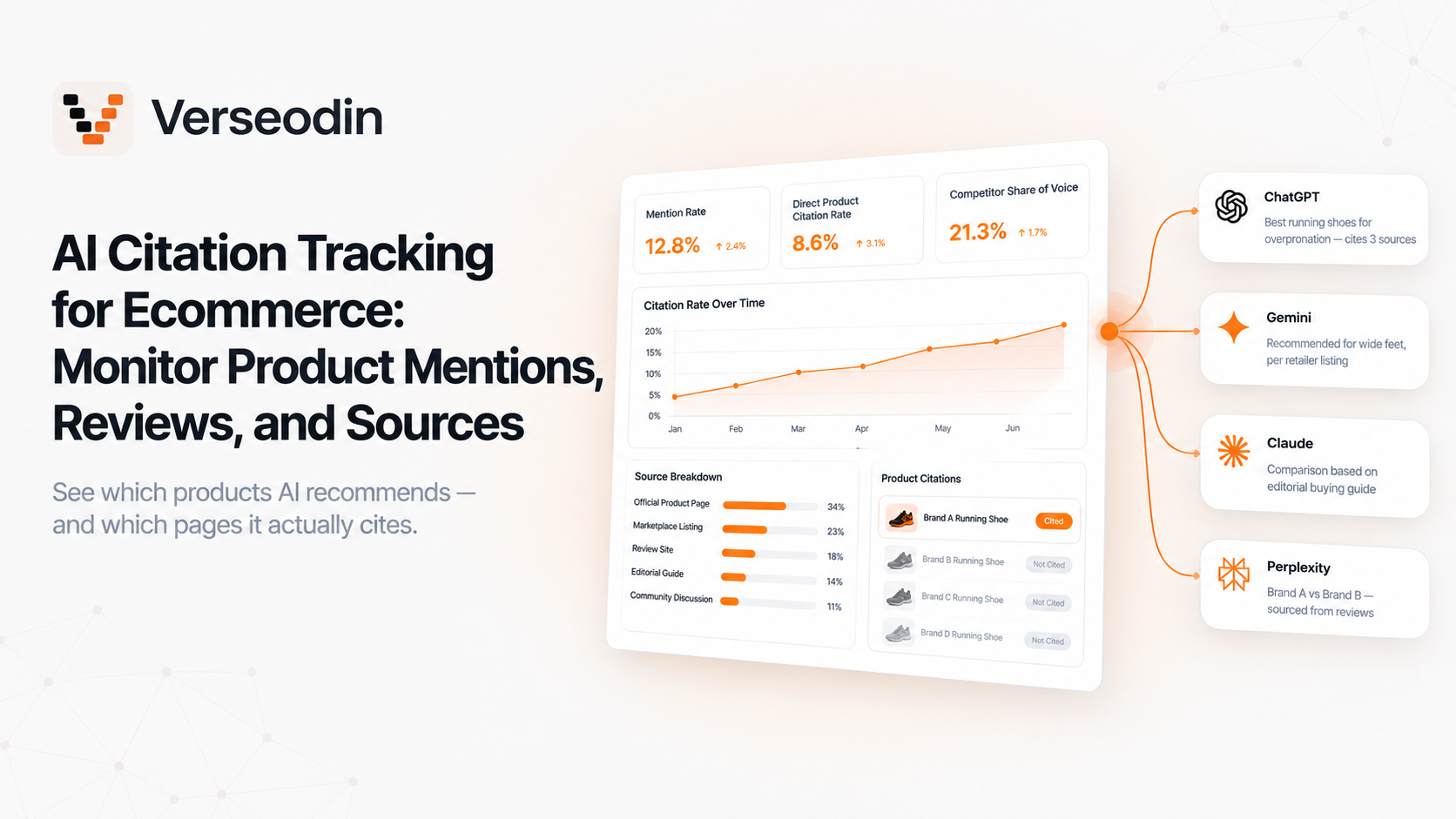
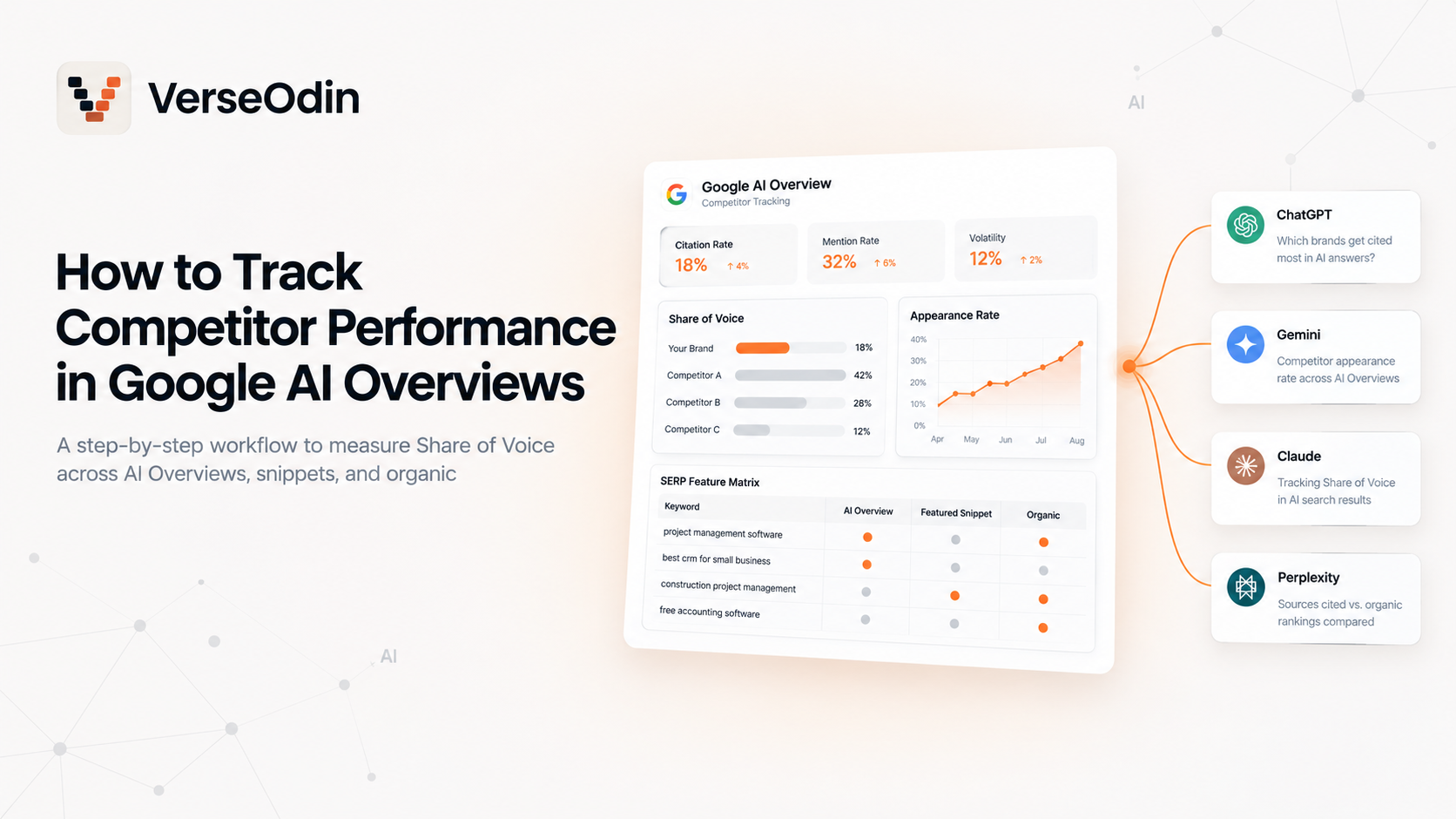
None of this is a one time project. Crawler behavior, llms.txt adoption, and which platforms actually act on content negotiation are all still moving. Verseodin tracks citation rate and mention rate across ChatGPT, Gemini, and Perplexity over time, which is what actually shows whether a structural change like this moved anything, rather than leaving that connection to guesswork.
Frequently Asked Questions
Do AI crawlers like GPTBot support content negotiation for markdown?
Not yet, based on the evidence available today. GPTBot, ClaudeBot, and PerplexityBot all still request standard HTML rather than sending an Accept: text/markdown header, the same way search crawlers always have. Independent server log tracking and industry research both point the same direction: the crawlers that train models and power AI search have not adopted content negotiation, even though a handful of coding agents and developer tools already have. Google-Extended is not a crawler at all, so the question does not apply to it the same way, it is only a robots.txt control token with no requests of its own to negotiate.
How do I optimize my website content for AI search crawlers?
Start with structure rather than format. Use a real heading hierarchy, make sure essential content renders in plain HTML rather than requiring JavaScript, add Article and FAQPage schema where it genuinely applies, and state direct answers early in a section instead of building up to them. Content negotiation and llms.txt are reasonable additions on top of that foundation, but structure and clear, citable writing move the needle more than either one on its own.
Does Google use llms.txt for search?
No. Google's search relations team has said this directly and repeatedly, both at public events and in its own published AI guidance, most recently updated in June 2026. Content that appeared on a handful of Google's own developer pages happened because an internal content system supported the format by default, not because Search reads or rewards it. Some other AI platforms and coding tools show more willingness to read the file when it exists, but no major AI company currently documents it as a required or guaranteed citation signal.
How can I check if AI crawlers can access my content?
Read the robots.txt file directly for the specific bot names that matter, then check server logs and verify any crawler visits against that vendor's officially published IP range, since a user agent string alone can be spoofed. Also check whether a firewall or CDN bot management layer is silently blocking AI crawlers regardless of what robots.txt says, since this is the most common cause of a block nobody intended to set up. Testing with JavaScript disabled shows roughly what a crawler sees, since most AI crawlers do not execute scripts.
How do I create an llms.txt file for AI crawlers?
Place a plain markdown file named llms.txt at a site's root address. Start with a single top level heading naming the site, add a short blockquote description underneath, then organize links to the most valuable pages under clear section headings, with one honest sentence describing what each page covers. Keep it curated rather than comprehensive, a short list of genuinely useful pages works better than an automatically generated dump of an entire sitemap, and recheck it periodically so it does not go stale as pages change.