Search engines do not read your content the way you wrote it. They read what it actually means, who it is about, and which real question it resolves, and none of that is guaranteed just because the right keyword sits in the title tag. A page can rank on the exact phrase it was built for and still never earn a single citation in an AI generated answer, because ranking and being understood turned out to be two different problems.
Semantic SEO is the practice built for the second problem. Entities, context, and intent stop being separate checklist items and start working as one system, which is exactly why a page built this way can earn a citation for a question phrased nothing like its original target keyword. Search engines stopped matching strings the moment Google rebuilt its core algorithm around meaning over a decade ago, and the AI answer engines built on that same shift, ChatGPT, Gemini, and Perplexity, have only pushed the logic further.
Most sites already have fragments of this in place without realizing it: schema on a handful of pages, a cluster that happens to be well linked, a heading that matches a real question by accident. What is rare is having all of it working together on purpose, so entities, context, structure, and intent reinforce each other instead of sitting in isolation. That difference is what separates a site a search engine merely indexes from one it actually trusts enough to cite.
What Is Semantic SEO?
Semantic SEO is the practice of structuring content so a search engine understands what it actually means, not just which words sit on the page. Instead of building a page around one exact phrase, semantic SEO teaches search engines and AI systems which entities a page actually covers, how those entities connect to one another, and which real question a reader is trying to answer. A semantic SEO strategy treats an entity, its surrounding context, and the intent behind a query as one connected system, not three separate boxes to check.
None of this is a new fad. Classic keyword SEO worked as a matching exercise: repeat a phrase in the title, the headers, and the body, and rank for that exact phrase. Google started replacing that logic more than a decade ago. Hummingbird, announced in September 2013, rebuilt the core algorithm around parsing the meaning behind a query rather than the literal words inside it, feeding directly off the Knowledge Graph Google had launched a year earlier. RankBrain followed in 2015 to interpret queries Google had never seen before, and BERT arrived in 2019 weighing every word in a query against every other word around it, so a small term like for or no could actually change what a query meant rather than getting ignored. Google's Multitask Unified Model, previewed in 2021, pushed the same idea across languages and formats at once. None of these updates were really about a single release. Each one replaced a little more string matching with meaning matching, and that same underlying shift is exactly what modern AI answer engines such as ChatGPT, Gemini, and Perplexity now do by default when they read a page.
Entity SEO, topical authority, and search intent optimization are often treated as separate disciplines with their own checklists. Semantic SEO is the wider practice that ties them together: a site earns semantic relevance when its entities are clearly defined, when the context around those entities is explicit rather than implied, and when the content itself actually matches the intent behind the questions it is meant to answer.
Semantic SEO: How Search Engines Use Entities, Context, and Search Intent
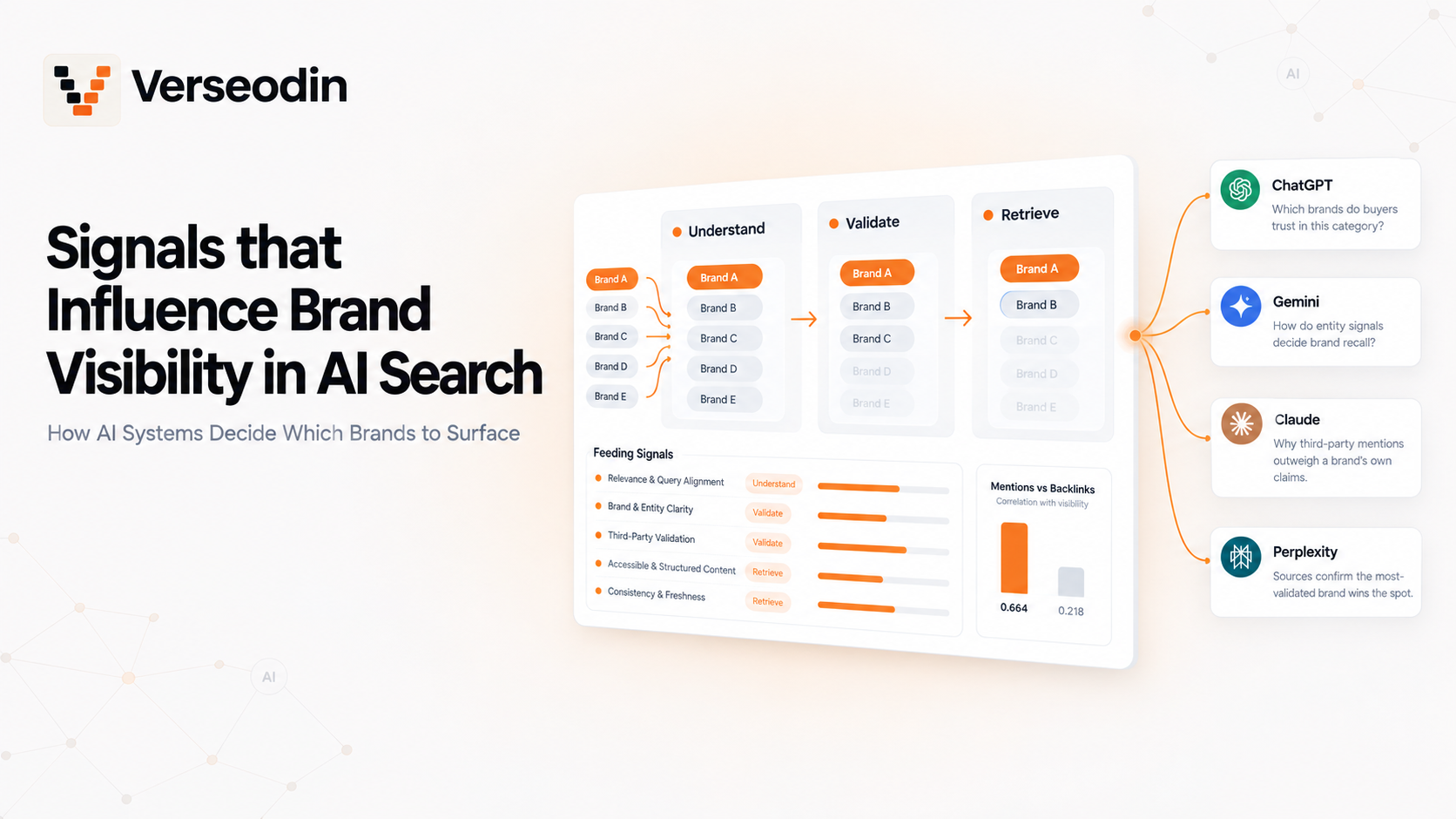
A search engine resolves a query in roughly three moves: it identifies the entity or entities the query is actually about, it gathers the surrounding context needed to understand what is being asked, and it matches that combination against the intent behind the question before it ever decides what to retrieve or generate. Semantic SEO is the discipline of making all three of those moves easy rather than something a system has to guess at.
Entity resolution comes first. A query rarely names a subject in isolation, and a search engine has to decide which specific brand, product, place, or concept a word or phrase actually refers to before it can do anything else with it. A page that names its subject consistently, and backs that up with structured data, gives a system a confident answer rather than a guess. Our closer look at how structured data and entities work together to make a website legible to AI systems covers the mechanics of that resolution step in far more depth.
Context is what turns a resolved entity into something usable. The same entity means something different depending on what sits around it: a product mentioned next to pricing language reads as commercial content, the same product mentioned next to setup instructions reads as support content. Search engines gather this context from the page itself, from the pages linked around it, and increasingly from the running exchange inside an AI answer engine, where each new question borrows meaning from whatever the person already asked rather than starting over from nothing.
Search intent is the filter all of this passes through last. Even a perfectly identified entity with rich context can lose a citation if the content behind it does not match what the searcher actually needs right now, whether that is a plain definition, a comparison, or a fast path to a purchase. The four broad intent categories, informational, navigational, commercial, and transactional, still hold up well as a working model, and a full breakdown of what each intent type actually looks like and how to write for it is worth reading before mapping content against any of them.
How Search Engines Use AI, NLP, and Entities to Understand Meaning and Context of Your Content
Underneath entity resolution and context matching sit a handful of specific natural language processing techniques, and understanding them at a basic level makes semantic SEO decisions far less like guesswork. The first is named entity recognition, a technique that scans text and tags which spans of words refer to a person, an organization, a product, or a place, essentially drawing boxes around the entities before anything else can happen to them. The second is disambiguation, the step that decides which real world entity a recognized name actually points to. A word like Amazon could name a company, a river, or a marketplace category, and a system has to pick one using the surrounding words, the page's own structured data, and often a cross check against an external reference like a knowledge graph entry.
Context understanding got dramatically better with the shift from static to contextual language models. Older NLP systems represented a word with one fixed numerical value no matter where it appeared, so bank meant the same thing whether the sentence was about a river or a loan. Bidirectional Encoder Representations from Transformers, the technique behind Google's BERT update, changed that by reading an entire sentence in both directions at once and weighing every word against every other word around it, an approach generally called attention. That is what lets a modern language model tell the difference between a river bank and a savings bank from context alone, without either sentence ever using the word finance or water.
This is also how AI systems build meaning across an entire page rather than one sentence at a time. Named entity recognition tags what a page is about, disambiguation confirms which specific entity that is, and contextual language understanding reads the relationships between those entities and the surrounding text well enough to place the page inside a much larger structure of related concepts. Our guide to how AI search engines assemble that structure into a conceptual map it can retrieve from picks up exactly where this technical layer leaves off.
Building a Semantic SEO Strategy With Topic Clusters, Entities, Search Intent, and Topical Depth
A semantic SEO strategy is the plan that turns entities, context, and intent from concepts into a structured body of content a search engine can actually trust. It works best as a sequence rather than a checklist tackled in random order.
- Define the core entity and its neighbors. Start with the exact brand, product, or subject the site needs to own, then list the entities that sit closest to it: competitors, integrations, use cases, and the specific terminology buyers actually use. This list becomes the vocabulary the rest of the strategy gets built on.
- Map the topic into a cluster. Break the core subject into every genuine subtopic, comparison, and edge case a reader would reasonably ask about, and assign each one its own page rather than folding everything into a single long article. Depth spread across a connected cluster reads as authority in a way that one exhaustive page never quite manages, and a closer look at why that kind of topical depth now outperforms keyword targeting walks through the reasoning in full.
- Assign a single search intent to each page. A page meant to explain a concept and a page meant to close a sale are answering two different needs, and stretching one page across both usually leaves neither need fully met. Every page in the cluster should commit fully to the one intent it was built for.
- Connect the cluster on purpose. A new page needs a real link back to whichever earlier pages it builds on, and those earlier pages deserve an update pointing forward too, so the relationships between entities and subtopics get stated outright instead of left for a system to work out on its own.
- Keep terminology and entity naming consistent across every page in the cluster, since a system that sees the same entity described three different ways has to work harder to confirm it is looking at one coherent source rather than three unrelated ones.
Topical depth is what actually builds topical authority, and it is what separates a strategy that works from one that only looks complete on paper. A cluster of five thin pages rarely outperforms three genuinely thorough ones, because depth, not page count, is what convinces a retrieval system a domain actually understands the subject rather than passing through it.
How to Structure Content for Semantic Search With Internal Links, Semantic HTML, and Schema
Strategy decides what a semantic SEO plan should cover. Structure decides whether a search engine can actually read that plan back out of the page. Three elements do most of the work here: internal links, semantic HTML, and schema markup, and each one states a different kind of relationship explicitly rather than leaving it implied.
Internal links are the most underused of the three. Beyond helping a reader navigate, a link is a direct, machine readable statement that two entities or subtopics are related, and descriptive anchor text turns that statement into something a retrieval system can actually act on rather than a generic read more pointing nowhere useful. A cluster where every page names and links its two or three closest siblings hands a search engine an explicit map of the topic, rather than several disconnected pages it has to piece together on its own.
Semantic HTML does the same job one layer down, at the markup itself rather than the words inside it. Wrapping a section in article or main instead of a generic div settles a question a parser would otherwise be left to guess: where the real content actually begins and ends. That answer carries far more weight once a retrieval system starts lifting individual passages rather than reading a page from top to bottom. Our full breakdown of the specific HTML5 elements worth using and how to arrange them covers the element by element detail this section only has room to summarize.
Schema markup, typically expressed as a small JSON-LD block, closes the loop by stating facts directly instead of asking a system to infer them from prose. A semantic SEO stack usually leans on a small set of types:
- Organization or Person schema to confirm exactly who or what the content is from.
- Article or BlogPosting schema to mark the boundaries of the actual content and attach an author and a date to it.
- FAQPage schema to give each question and answer pair its own extractable, self contained unit.
- BreadcrumbList schema to state where a page sits inside the site's own topical hierarchy.
Used together, internal links, semantic HTML, and schema stop being three separate technical tasks and start acting as three independent, agreeing signals pointing at the same underlying structure, which is exactly the kind of redundancy that makes a system confident enough to cite what it finds.
Semantic SEO Gap Analysis: How to Find Missing Topics, Entities, Search Intent, and Content Relationships
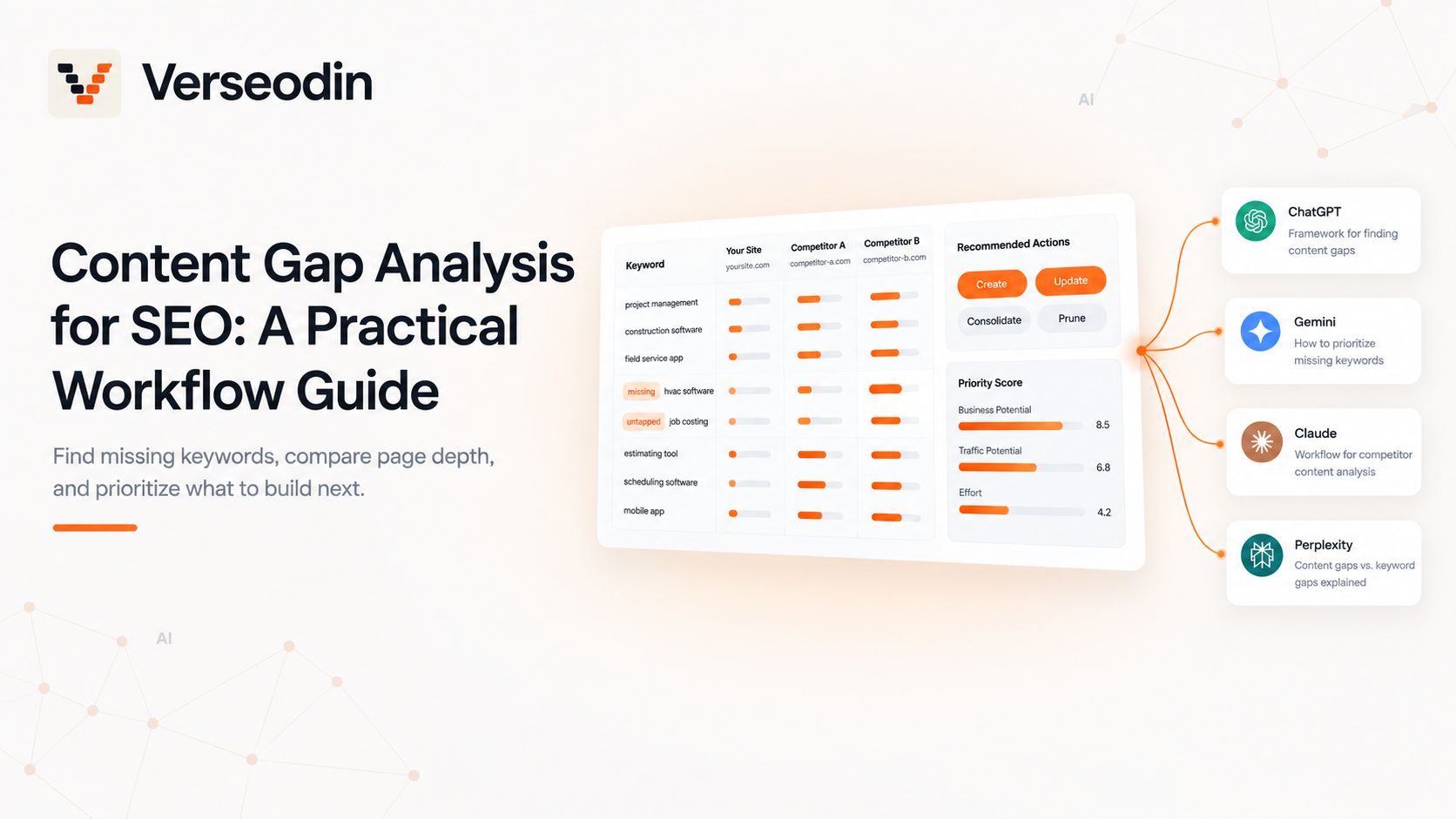
A semantic SEO gap analysis is a systematic check for what a site's content is missing, run across four layers rather than one. Most sites have gaps in all four without realizing it, since each layer tends to get audited on its own, if it gets audited at all.
- Topic gaps. List every subtopic, comparison, and follow up question a real buyer would eventually raise about the core subject, then check which of those already has a dedicated page behind it. A gap is any reasonable question with nothing built to answer it.
- Entity gaps. Look at what competitors and top ranking pages mention that the site does not: related products, integrations, comparison brands, or industry terms. An entity gap means a system has less reason to connect the site to that surrounding vocabulary at all.
- Search intent gaps. Check the intent mix across the whole site rather than page by page. A site with fifteen informational guides and zero comparison or transactional pages has a structural intent gap, even if every individual page is well written.
- Content relationship gaps. Find pages that cover related subjects but never link to each other. A relationship gap is not missing content, it is existing content that a search engine cannot confidently connect because nothing on either page states the relationship outright.
These gaps are more common than most teams expect. An audit of 1,000 domains by Fuel Online's 2026 AI Index found an average technical readiness score of only 46 out of 100, and just 12.4 percent of the sites reviewed had complete Organization schema in place, the single most basic entity signal a semantic SEO gap analysis would check first. Running this same four layer check on your own site, then prioritizing the gaps that sit closest to your core entity, is a far more direct route to closing the distance than publishing content at random and hoping it eventually adds up to full coverage.
How to Conduct a Semantic SEO Audit and Strengthen Your Site's Topical Relevance
Where a gap analysis asks what is missing, a semantic SEO audit asks how well everything that already exists is actually working. It is a health check across the same layers a strategy is built on, run on a schedule rather than once and forgotten.
Try it with your own website
See the prompts real buyers ask AI assistants in your category.
- Audit entity clarity. Pull every page that mentions your core brand or product and confirm the name, description, and category read identically everywhere. Inconsistent naming across even a handful of pages reintroduces exactly the ambiguity a clean entity is supposed to remove.
- Validate structured data. Run every templated page type through a schema validator rather than assuming markup that was correct at launch is still correct today. Schema fails silently far more often than teams expect, and a broken block is functionally the same as having none at all.
- Check cluster completeness. Revisit the topic map behind each content cluster and confirm every planned subtopic actually has a published page, and that none of those pages have quietly gone stale since launch.
- Review intent alignment. Read a sample of pages against the query they were written for and confirm the format still matches the intent, since a page written for one intent has a way of drifting toward a different one after a few rounds of edits.
- Test relationship signals. Spot check internal links, semantic HTML boundaries, and heading hierarchy on a handful of representative pages rather than assuming the whole site still follows the original structure.
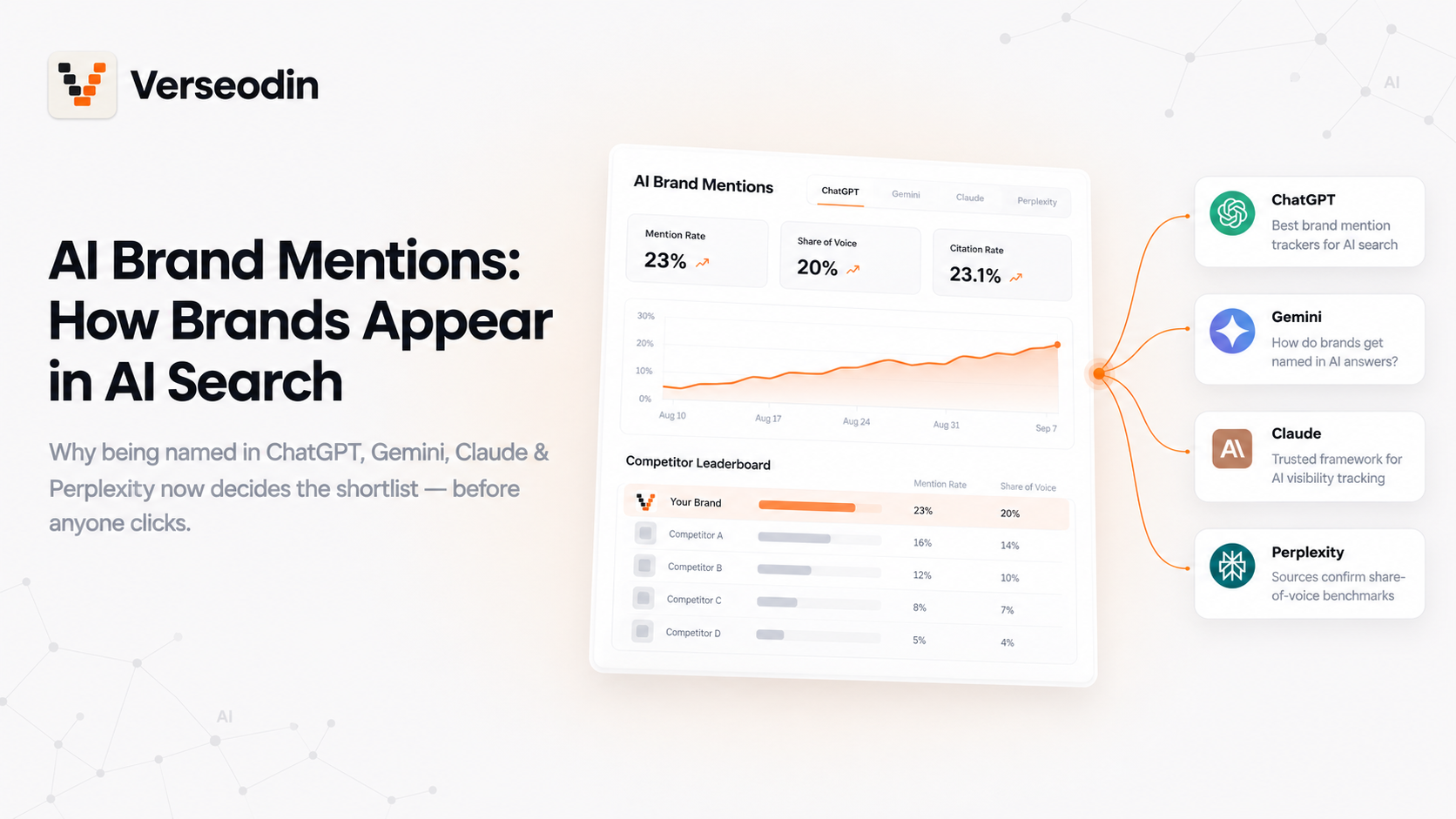
A semantic SEO audit works best as a recurring rhythm rather than a single push. Sites that revisit entity naming, schema validity, and cluster completeness on a fixed cadence catch small inconsistencies while they are still cheap to fix, instead of finding out months later that a dozen pages have quietly drifted out of alignment with each other. Verseodin measures the outcome of that discipline directly, tracking whether a brand's mentions and citations across ChatGPT, Gemini, and Perplexity actually move once an audit closes a specific gap, rather than leaving the impact to guesswork.
Frequently Asked Questions
What makes semantic SEO different from writing for a single keyword?
Writing for a single keyword means shaping one page around one exact phrase and measuring success by where that phrase ranks. Semantic SEO optimizes for meaning instead: clearly defined entities, explicit context, and intent matching across a whole body of content, so a page can earn a citation for a related question even when that question never contains the page's original target phrase.
Is entity SEO the same thing as semantic SEO?
Entity SEO is one part of semantic SEO, not the whole of it. Entity SEO focuses specifically on making sure a brand, product, or concept is clearly and consistently identified. Semantic SEO is the broader practice that also includes context, search intent, topic clusters, and technical structure working together around those entities.
How is semantic SEO different from GEO and AEO?
Generative engine optimization and answer engine optimization are focused specifically on earning citations inside AI generated answers. Semantic SEO is the older, broader foundation both of them build on: understanding entities, context, and intent well enough to be understood by any system, whether that system returns a ranked list of links or a synthesized answer.
Do you need schema markup to do semantic SEO?
Schema markup is not strictly required, since a system can still infer entities and relationships from consistent naming and clear prose alone. It is, however, the fastest way to remove ambiguity, since it states facts directly rather than asking a system to guess at them, which is why it shows up in nearly every practical semantic SEO checklist.
How often should you run a semantic SEO audit?
A full audit once a quarter is a reasonable default for most sites, with entity naming and schema validation checked more frequently on any page that gets edited. Sites publishing new content clusters at a fast pace benefit from auditing sooner, since gaps and inconsistencies compound quickly across a growing cluster if they are left unchecked.